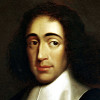
“ A free man thinks of death least of all things; and his wisdom is a meditation not of death but of life. ”
Baruch Spinoza, Ethics (1677). copy citation
| Author | Baruch Spinoza |
|---|---|
| Source | Ethics |
| Topic | wisdom death |
| Date | 1677 |
| Language | English |
| Reference | |
| Note | Translated by R. H. M. Elwes |
| Weblink | http://www.gutenberg.org/files/3800/3800-h/3800-h.htm |
Context
“the latter is his own master and only performs such actions, as he knows are of primary importance in life, and therefore chiefly desires; wherefore I call the former a slave, and the latter a free man, concerning whose disposition and manner of life it will be well to make a few observations.
PROP. LXVII. A free man thinks of death least of all things; and his wisdom is a meditation not of death but of life.
Proof.—A free man is one who lives under the guidance of reason, who is not led by fear (IV. lxiii.) , but who directly desires that which is good (IV. lxiii. Coroll.) , in other words (IV. xxiv.)”
source