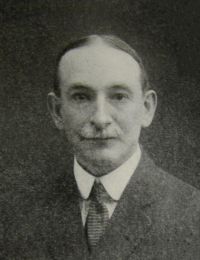
Alfred Newton and Hans Friedrich Gadow

Biographical details

Alfred Newton and Hans Friedrich Gadow 1911 Encyclopædia Britannica (1911)

The tailor-bird deliberately spins a thread of cotton and therewith stitches together the edges of a pair of leaves to make a receptacle for its nest. Beautiful, too, is the felt fabricated of fur or hairs by the various species of titmouse, while many birds ingeniously weave into a compact mass both animal and vegetable fibres, forming an admirable non-conducting medium which guards the eggs from the extremes of temperature outside.
Source: Wikisource

Alfred Newton and Hans Friedrich Gadow 1911 Encyclopædia Britannica (1911)

Many of the gulls, sandpipers and plovers lay their eggs in a shallow pit which they hollow out in the soil, and then as incubation proceeds add thereto a low breastwork of haulm. The ringed plover commonly places its eggs on shingle, which they so much resemble in colour, but when breeding on grassy uplands it paves the nest-hole with small stones. Pigeons mostly make an artless platform of sticks so loosely laid together that their pearly treasures maybe perceived from beneath by the inquisitive observer.
Source: Wikisource

Alfred Newton and Hans Friedrich Gadow 1911 Encyclopædia Britannica (1911)

Birds there are of eminently social predilections. In Europe, apart from sea-fowls whose congregations are universal and known to all only the heron, the fieldfare and the rook habitually flock during the breeding season; but in other parts of the world many birds unite in company at that time, and in none possibly is this habit so strongly developed as in the anis of the neotropical region, the republican swallow of North America and the sociable grosbeak of South Africa, which last joins nest to nest until the tree is said to break down under the accumulated weight of the common edifice.
Source: Wikisource

Get perspective with Kwize: daily news enlightened by great literature