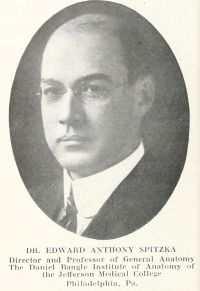
Edward Anthony Spitzka

Biographical details

Portrait of Edward Anthony Spitzka Edward Anthony Spitzka 1911 Encyclopædia Britannica (1911)

The mechanism of life, circulation and respiration cease with the first contact. Consciousness is blotted out instantly, and the prolonged application of the current ensures permanent derangement of the vital functions beyond recovery. Occasionally the drying of the sponges through undue generation of heat causes desquamation or superficial blistering of the skin at the site of the electrodes. Post-mortem discoloration, or post-mortem lividity, often appears during the first contact. The pupils of the eyes dilate instantly and remain dilated after death.
Source: Wikisource

Portrait of Edward Anthony Spitzka Edward Anthony Spitzka 1911 Encyclopædia Britannica (1911)

The ammeter usually shows that from 7 to 10 amperes pass through the criminal’s body. A second or even a third brief contact is sometimes made, partly as a precautionary measure, but rather the more completely to abolish reflexes in the dead body. Calculations have shown that by this method of execution from 7 to 10 h. p. of energy are liberated in the criminal’s body. The time consumed by the strapping-in process is usually about 45 seconds, and the first contact is made about 70 seconds after the criminal has entered the death-chamber.
Source: Wikisource

Portrait of Edward Anthony Spitzka Edward Anthony Spitzka 1911 Encyclopædia Britannica (1911)

The law provides that there shall be present, in addition to the warden, two physicians, twelve reputable citizens of full age, seven deputy sheriffs, and such ministers, priests or clergymen, not exceeding two, as the criminal may request. A post-mortem examination of the body of the convict is required, and the body, unless claimed by relatives, is interred in the prison cemetery with a sufficient quantity of quicklime to consume it.
Source: Wikisource

Get perspective with Kwize: daily news enlightened by great literature