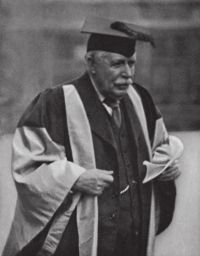
Frederick George Meeson Beck

Biographical details

Frederick George Meeson Beck 1911 Encyclopædia Britannica (1911)

For these reasons the story of the foundation of Wessex, though it appears to possess considerable antiquity, must be regarded as open to grave suspicion. It is worthy of note that the dynasty claimed to be of the same origin as the royal house of Bernicia and that two of Cerdic's ancestors, Freawine and Wig, figure in the story of Wermund, king of Angel.
Whatever may be the truth about the origin of the kingdom, and it is by no means impossible that the invasion really proceeded from a different quarter, we need not doubt that its dimensions were largely increased under Ceawlin.
Source: Wikisource

Frederick George Meeson Beck 1911 Encyclopædia Britannica (1911)

SUEBI, or Suevi, a collective term applied to a number of peoples in central Germany, the chief of whom appear to have been the Marcomanni, Quadi, Hermunduri, Semnones and Langobardi. From the earliest times these tribes inhabited the basin of the Elbe. The Langobardic territories seem to have lain about the lower reaches of the river, while the Semnones lay south.
Source: Wikisource

Frederick George Meeson Beck 1911 Encyclopædia Britannica, Volume 18… (1911)

In 872 the Danes occupied London on their return from invading Wessex, after which a truce was again made. In 873 the Danes encamped at Torksey in Lincolnshire, and although another truce ensued, they advanced in the following year to Repton, and Burgred was driven from the kingdom. He went to Rome, where he remained until his death. In 874 Ceolwulf, a king’s thegn or baron, was made king by the Danes, and definitely acknowledged their overlordship. In 877, after the second invasion of Wessex, the Danes seem to have taken the eastern part of Mercia into their own hands.
Source: Wikisource

Get perspective with Kwize: daily news enlightened by great literature