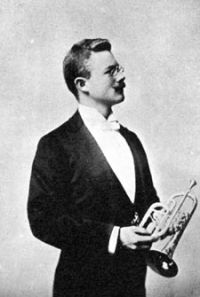
Herbert L. Clarke

Biographical details

Portrait of Herbert L. Clarke Herbert L. Clarke,  Characteristic Studies (1915)

“ First, always practice softly; try to produce a light positive attack in the middle register. My tongue is never rigid when playing, and rests at the bottom of my mouth, the end pressed slightly against the lower teeth. I then produce the staccato, by the centre of the tongue striking against the roof of the mouth. This I have practiced so as to acquire rapid single Tongueing without fatigue, nor causing a clumsy tone, and when under full control, Double and Triple Tongueing becomes a simple matter by diligent practice, keeping the mind upon each articulation. ”
Source: Wikisource

Portrait of Herbert L. Clarke Herbert L. Clarke,  Characteristic Studies (1915)

“ To produce a sforzando attack, such as in Trumpet playing, the point of the tongue is used decisively. In my Elementary Studies, First Series, I state that there is no set rule for cornet playing, except by playing naturally; consequently there is no set rule for Tongueing. Each player must discover the most natural and easiest way for himself. There is any amount of experimenting necessary, before one really feels the proper way. Use of the syllable "Tu", not "Thu" in the middle register, seems to be the most natural way to express the attack. ”
Source: Wikisource

Portrait of Herbert L. Clarke Herbert L. Clarke,  Characteristic Studies (1915)

“ When full control of the tongue is acquired, practice all scale exercises with the Metronome, which ticks regularly, and keeps perfect time. Be sure each articulation is even and equal, in tonal quality, also positive in attack.
There are as many different articulations on the cornet, as bowings on the violin, and every cornetist should acquaint himself thoroughly with all of these to be a good player, as they are used frequently in all kinds of cornet playing.
”
Source: Wikisource

Get perspective with Kwize: daily news enlightened by great literature