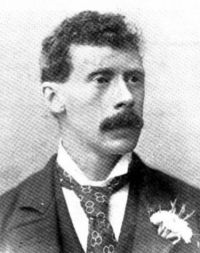
A. T. Quiller-Couch

A. T. Quiller-Couch

Summary

Portrait of A. T. Quiller-Couch A. T. Quiller-Couch True Tilda — Epilogue (1909)

At the foot of the orchard, and on the very edge of the woodland, lies a small enclosure, where from the head of the slope you catch sight, between the apple trees, of a number of white stones glimmering; but your eyes rest rather on the figure of a girl who has just left the enclosure, and is mounting the slope with a spade on her shoulder.
You watch her, yourself invisible, while she approaches. You might gaze until she has passed, and yet not recognise her for Tilda.
Source: Wikisource

Portrait of A. T. Quiller-Couch A. T. Quiller-Couch True Tilda — Epilogue (1909)

Tilda's face is grave, however, as she stands there in the morning sunshine. She is looking back upon the enclosure where the white stones overtop the blue-bells. They are headstones, and mark the cemetery where Miss Sally, not ordinarily given to sentiment, has a fancy for interring her favourite dogs.
You guess now why Tilda carries a spade, and what has happened, but may care to know how it happened.
Sir Elphinstone is paying a visit just now to Culvercoombe. He regards Tilda with mixed feelings, and Tilda knows it. The knowledge nettles her a little and amuses her a good deal.
Source: Wikisource

Portrait of A. T. Quiller-Couch A. T. Quiller-Couch True Tilda — Epilogue (1909)

Time had taken away the old Tilda with the old 'Dolph. She was a girl grown, a girl with limbs firmed by outdoor sports and country living. And she had learnt much—so much, that to have learnt it she had necessarily forgotten much. You or I, meeting her this morning for the first time, had made no doubt of her being a young lady of rather exceptional breeding.
She looked back to the spot where 'Dolph rested among dogs of loftiest race. She knew that Sir Elphinstone and Miss Sally were discussing her while they rode, and she could hear two words Sir Elphinstone let fall.
Source: Wikisource

Get perspective with Kwize: daily news enlightened by great literature