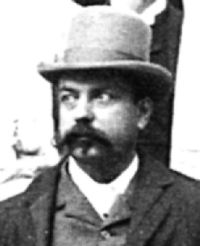
Albert Houtum-Schindler

Albert Houtum-Schindler

Summary

Portrait of Albert Houtum-Schindler Albert Houtum-Schindler 1911 Encyclopædia Britannica, Volume 4… (1911)

The houses being mostly built of a white conglomerate stone of shells and coral which forms the peninsula, gives the city when viewed from a distance a clean and handsome appearance, but on closer inspection the streets are found to be very narrow, irregular, ill-paved and filthy. Almost the only decent buildings are the governor’s palace, the British residency and the houses of some well-to-do merchants.
Source: Wikisource

Portrait of Albert Houtum-Schindler Albert Houtum-Schindler 1911 Encyclopædia Britannica, Volume 4… (1911)

In the first half of the 18th century, when Bushire was an unimportant fishing village, it was selected by Nadir Shah as the southern port of Persia and dockyard of the navy which he aspired to create in the Persian Gulf, and the British commercial factory of the East India Company, established at Gombrun, the modern Bander Abbasi, was transferred to it in 1759. At the beginning of the 19th century it had a population of 6000 to 8000, and it is now the most important port in the Persian Gulf, with a population of about 25,000.
Source: Wikisource

Portrait of Albert Houtum-Schindler Albert Houtum-Schindler 1911 Encyclopædia Britannica, Volume 4… (1911)

It used to be under the government of Fars, but is (since about 1892) the seat of the governor of the Persian Gulf ports, who is responsible to the central government, and has under his jurisdiction the principal ports of the Gulf and their dependencies. The town, which is of a triangular form, occupies the northern extremity of a peninsula 11 m. long and 4 broad, and is encircled by the sea on all sides except the south. It is fortified on the land side by a wall with 12 round towers.
Source: Wikisource

Get perspective with Kwize: daily news enlightened by great literature