Summary

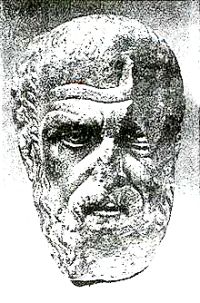
Portrait of Arrian Arrian The Anabasis of Alexander — Chapter VI (1884)

They, seeing the force crossing the river, marched down the mountains to meet them, with the purpose of attacking Alexander's rear in its retreat. But, as they were just drawing near, Alexander rushed forth with his own division, and the phalanx raised the battle-cry, as if about to advance through the river. When the enemy saw all the Macedonians marching against them, they turned and fled. Upon this, Alexander led the Agrianians and archers at full speed towards the river, and succeeded in being himself the first man to cross it.
Source: Wikisource

Portrait of Arrian Arrian The Anabasis of Alexander — Chapter VI (1884)

Directly Glaucias perceived that Alexander was advancing, he evacuated the mountains, and Philotas and his forces returned to the camp in safety. But Clitus and Glaucias still imagined that they had caught Alexander in a disadvantageous position; for they were occupying the mountains, which commanded the plain by their height, with a large body of cavalry, javelin-throwers, and slingers, besides a considerable number of heavy armed infantry. Moreover, the men who had been beleaguered in the city were expected to pursue the Macedonians closely if they made a retreat.
Source: Wikisource

Portrait of Arrian Arrian The Anabasis of Alexander — Chapter VI (1884)

His intention was to fall upon the Macedonians from all sides, if they assaulted the city. But Glaucias, king of the Taulantians, had not yet joined him. Alexander, however, led his forces towards the city; and the enemy, after sacrificing three boys, an equal number of girls, and three black rams, sallied forth for the purpose of receiving the Macedonians in a hand-to-hand conflict. But as soon as they came to close quarters, they left the positions which they had occupied, strong as they were, [11] in such haste that even their sacrificial victims were captured still lying on the ground.
Source: Wikisource

Get perspective with Kwize: daily news enlightened by great literature