Summary

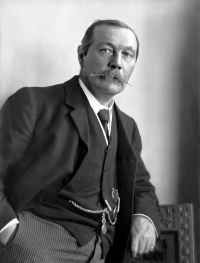
Portrait of Arthur Conan Doyle Arthur Conan Doyle Beyond the City — Chapter 16: A Midnight Visitor (1892)

Her sister gave a gasp of horror, and stood with a clutch at Monica's arm, staring in the same direction.
There was a light in the front room, a slight, wavering light such as would be given by a small candle or taper. The blind was down, but the light shone dimly through. Outside in the garden, with his figure outlined against the luminous square, there stood a man, his back to the road, his two hands upon the window ledge, and his body rather bent as though he were trying to peep in past the blind.
Source: Wikisource

Portrait of Arthur Conan Doyle Arthur Conan Doyle Beyond the City — Chapter 16: A Midnight Visitor (1892)

She lay outstretched, dressed in her ordinary clothes, the extinguished taper still grasped in her hand, no mark or wound upon her--pale, placid, and senseless.
"Thank God you are come, Doctor," said Charles, looking up. "Do tell me how she is, and what I should do."
Doctor Walker kneeled beside her, and passed his left hand over her head, while he grasped her pulse with the right.
"She has had a terrible blow," said he. "It must have been with some blunt weapon. Here is the place behind the ear. But she is a woman of extraordinary physical powers. Her pulse is full and slow.
Source: Wikisource

Portrait of Arthur Conan Doyle Arthur Conan Doyle Beyond the City — Chapter 16: A Midnight Visitor (1892)

Now all this time, while the tragi-comedy of life was being played in these three suburban villas, while on a commonplace stage love and humor and fears and lights and shadows were so swiftly succeeding each other, and while these three families, drifted together by fate, were shaping each other's destinies and working out in their own fashion the strange, intricate ends of human life, there were human eyes which watched over every stage of the performance, and which were keenly critical of every actor on it.
Source: Wikisource

Get perspective with Kwize: daily news enlightened by great literature