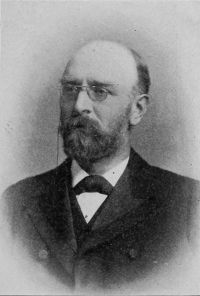
Arthur Smith Woodward

Arthur Smith Woodward

Summary

Portrait of Arthur Smith Woodward Arthur Smith Woodward 1911 Encyclopædia Britannica, Volume 8… (1911)

There are 104 vertebrae, namely, 15 in the neck, 11 in the back, 5 in the sacrum and 73 in the tail. The presacral vertebrae are of remarkably light construction, the plates and struts of bone being arranged to give the greatest strength with the least weight. The end of the tail is a flexible lash, which would probably be used as a weapon, like the tail of some existing lizards. The feet, notwithstanding the weight they had to support, are as unsymmetrical as those of a crocodile, with claws only on the three inner toes. There is no external armour.
Source: Wikisource

Portrait of Arthur Smith Woodward Arthur Smith Woodward 1911 Encyclopædia Britannica, Volume 8… (1911)

Marsh’s specimen in Washington supplied the greater part of the skull; and the fore-foot is copied from a specimen in New York.
The cast of the reconstructed skeleton of Diplodocus carnegii measures 84 ft. in length and 12 ft. 9 in. in maximum height at the hind-limbs. It displays the elongated neck and tail and the relatively small head so characteristic of the Sauropodous Dinosaurs. The skull is inclined to the axis of the neck, denoting a browsing animal; while the feeble blunt teeth and flat expanded snout suggest feeding among succulent water-weeds.
Source: Wikisource

Get perspective with Kwize: daily news enlightened by great literature