Summary

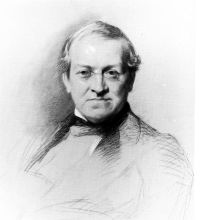
Portrait of Charles Wheatstone Charles Wheatstone Note relating to M. Foucault's new mechanical proof of the Rotation of the Earth… (1851)

When the rod or string is equally flexible in every direction, the plane of vibration given to it from any original impulse is constantly maintained whatever may be the velocity of rotation communicated to its point of support, provided the axis of vibration remains in the same position, or move only parallel to itself.
Source: Wikisource

Portrait of Charles Wheatstone Charles Wheatstone Note relating to M. Foucault's new mechanical proof of the Rotation of the Earth… (1851)

The difficulty, however, of the mathematical investigation of the subject, and the delicacy of the experiment, liable as it is to so many extraneous causes of error, have induced many persons to doubt either the reality of the phenomenon or the satisfactoriness of the explanation. Another experimental proof, therefore, not depending on the rotation of the earth, that the plane of oscillation of a vibrating line remains at rest with relation to the vertical component of the real axis of rotation, may not be unacceptable.
Source: Wikisource

Portrait of Charles Wheatstone Charles Wheatstone Note relating to M. Foucault's new mechanical proof of the Rotation of the Earth… (1851)

A spiral spring wire, by means of which a slow vibration is obtained with a comparatively short length, is attached at the lower end to a pin fixed in the axis of the semicircle, so that the point of attachment may be the axis of rotation, and at the upper end it is fixed to a similar pin in a parallel position fixed to the rider.
Source: Wikisource

Get perspective with Kwize: daily news enlightened by great literature