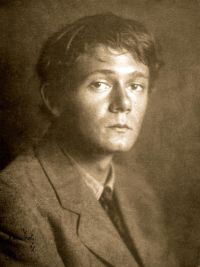
Clark Ashton Smith

Clark Ashton Smith

Summary

Portrait of Clark Ashton Smith Clark Ashton Smith Who are the Living? (1942)

I shall speak, however, of certain strange ideas with which Tomeron was much preoccupied, and concerning which he so often discoursed to me in that deep, guttural and monotonous voice of his, that had the reverberation of unsounded caverns in its tones and cadences. He maintained that life and death were not the fixed conditions that people commonly believed them to be; that the two realms were often intermingled in ways not readily discerned, and had penumbral border-lands; that the dead were not always the dead, nor the living the living, as such terms are habitually understood.
Source: Wikisource

Portrait of Clark Ashton Smith Clark Ashton Smith Who are the Living? (1942)

He moved always with the slow, meditative pace of one who dwells among far-off memories and reveries; and he spoke often of people and events and ideas that have long since been forgotten. For the most part, he was apparently unheedful of present things, and I felt that for him the huge city of Ptolemides, in which we both dwelt, with all its manifold clamor and tumult, was little more than a labyrinth of painted vapors. There was a like vagueness in the attitude of others toward Tomeron
Source: Wikisource

Portrait of Clark Ashton Smith Clark Ashton Smith Who are the Living? (1942)

At length we rounded a sudden angle of the low cavern we were following. Here we came to vaults that evidently belonged to some noble family, for they were quite spacious and there was but one sarcophagus in each vault.
'My ancestors and my family lie here,' announced Tomeron.
We reached the cavern's end and were confronted by a blank walL At one side was the final vault, in which an empty sarcophagus stood open. The sarcophagus was wrought of the finest bronze and was richly carven.
Source: Wikisource

Get perspective with Kwize: daily news enlightened by great literature