Summary

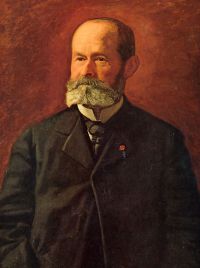
Portrait of Daniel G. Brinton Daniel G. Brinton Professor Blumentritt's studies of the Philippines (1899)

As no one is better informed than Professor Blumentritt on the actual mental status of the Filipinos, it will interest readers to learn that he is positive they are sufficiently advanced to be capable of independent self-government, and it is his ardent wish that this shall be the outcome of our wresting them from Spanish misrule.
Source: Wikisource

Portrait of Daniel G. Brinton Daniel G. Brinton Professor Blumentritt's studies of the Philippines (1899)

Here, as everywhere, man is the most important factor in the problem of government, and a thorough acquaintance with the diverse inhabitants of the archipelago should be sought by everyone interested in its development.
At present, I wish to direct attention to the articles on the Philippines of an author who stands easily first among scientific writers upon them, and who has devoted his life to investigations concerning them—I mean Prof. Ferdinand Blumentritt.
Source: Wikisource

Portrait of Daniel G. Brinton Daniel G. Brinton Professor Blumentritt's studies of the Philippines (1899)

Wild Tribes of Northern Luzon.—The name “Igorrotes” is applied by Spanish writers in a vague way to many wild tribes. Professor Blumentritt has endeavored to assign it a definite ethnographic meaning, which, it is to be hoped, American writers will adopt (Ausland, 1882, and in the “Alphabetic List,” already mentioned) . Special studies are given on the Calingas (Ausland, 1891) ; the Ilocanes (ibid., 1885) ; the Tinguianes (Mittheilungen of the Vienna Geographical Society, 1887)
Source: Wikisource

Get perspective with Kwize: daily news enlightened by great literature