Summary

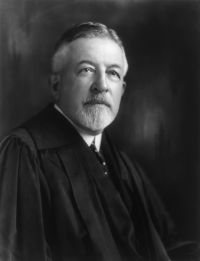
Portrait of Edward Terry Sanford Edward Terry Sanford Davis v. Wolfe — Opinion of the Court

The rule clearly deducible from these four cases is that, on the one hand, an employee cannot recover under the Safety Appliance Act if the failure to comply with its requirements is not a proximate cause of the accident which results in his injury, but merely creates an incidental condition or situation in which the accident, otherwise caused, results in such injury
Source: Wikisource

Portrait of Edward Terry Sanford Edward Terry Sanford Davis v. Wolfe — Opinion of the Court

While there is no previous decision of this Court relating to this aspect of Section 4, a controlling analogy is to be found in its decisions as to the application of Section 2 of the Act, which, as amended, makes it unlawful to use on a railroad engaged in interstate commerce any car not equipped with automatic couplers capable of being coupled and uncoupled 'without the necessity of men going between the ends of the cars.' This section has been considered in four cases in which the injured employees were not engaged either in coupling or uncoupling or in any service connected therewith.
Source: Wikisource

Portrait of Edward Terry Sanford Edward Terry Sanford Davis v. Wolfe — Opinion of the Court

In these cases it was held that, the collisions not being proximately attributable to the absence of automatic couplers on the standing cars, the carriers were not liable for the injuries received by the employees, even if the collisions would not have resulted in injuries to them had the couplers been on the standing cars, the requirement of automatic couplers not being intended to provide a place of safety between cars brought into collision through other causes.
Source: Wikisource

Get perspective with Kwize: daily news enlightened by great literature