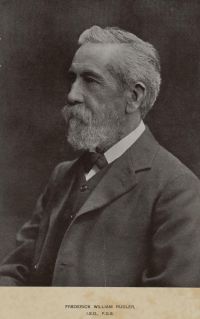
Frederick William Rudler

Frederick William Rudler

Summary

Portrait of Frederick William Rudler Frederick William Rudler 1911 Encyclopædia Britannica, Volume 16… (1911)

The colour is generally a fine azure or rich Berlin blue, but some varieties exhibit green, violet and even red tints, or may be altogether colourless. The colour is sometimes improved by heating the stone. Under artificial illumination the dark-blue stones may appear almost black. The mineral is opaque, with only slight translucency at thin edges.
Source: Wikisource

Portrait of Frederick William Rudler Frederick William Rudler 1911 Encyclopædia Britannica, Volume 16… (1911)

In addition to the blue cubic minerals in lapis lazuli, the following minerals have also been found: a non-ferriferous diopside, an amphibole called, from the Russian mineralogist, koksharovite, orthoclase, plagioclase, a muscovite-like mica, apatite, titanite, zircon, calcite and pyrite. The calcite seems to form in some cases a great part of the lapis; and the pyrite, which may occur in patches, is often altered to limonite.
Source: Wikisource

Get perspective with Kwize: daily news enlightened by great literature