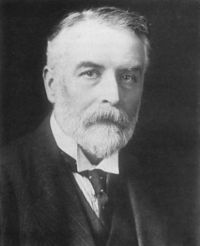
George Albert Boulenger

George Albert Boulenger

Summary

Portrait of George Albert Boulenger George Albert Boulenger 1911 Encyclopædia Britannica, Volume 8… (1911)

They are seldom found in deep water, preferring sandy bays, among the weeds growing on the bottom of which they lie in wait for their prey, and in securing this they are greatly assisted by their great width of gape, by their power of protruding the mouth, and by the slender filaments of the first dorsal fins, which float like worms in the water, while the greater part of the body is buried in the sand, and thus they entice the smaller fishes to come within easy reach of the capacious jaws.
Source: Wikisource

Portrait of George Albert Boulenger George Albert Boulenger 1911 Encyclopædia Britannica, Volume 8… (1911)

This affinity is further supported by the observations made by L. W. Byrne [3] on the asymmetry in the number and arrangement of the bony plates at the base of the dorsal and anal fins in the young of the John Dory. (G. A. B.)
↑ “Die Vorfahren der Schollen,” Biol. Centralbl. xxii. (1902) , p. 717. ↑ “On the systematic position of the Pleuronectidae,” Ann. and Mag. N. H. x. (1902) , p. 295. ↑ “On the number and arrangement of the bony plates of the young John Dory,” Biometrika, ii.
Source: Wikisource

Get perspective with Kwize: daily news enlightened by great literature