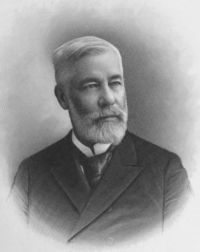
Horace Carter Hovey

Horace Carter Hovey

Summary

Portrait of Horace Carter Hovey Horace Carter Hovey 1911 Encyclopædia Britannica (1911)

The natural arch that admits one to Mammoth Cave has a span of 70 ft., and from a ledge above it a cascade leaps 59 ft. to the rocks below, where it disappears. A flight of stone steps leads the way down to a narrow passage, through which the air rushes with violence, outward in summer and inward in winter. The temperature of the cave is uniformly 54° F. throughout the year, and the atmosphere is both chemically and optically of singular purity. While the lower levels are moist from the large pools and rivers that have secret connexion with Green river, the upper galleries are extremely dry.
Source: Wikisource

Portrait of Horace Carter Hovey Horace Carter Hovey 1911 Encyclopædia Britannica (1911)

Again, there are chambers with drifts of snowy crystals of the sulphate of magnesia, the ceilings so thickly covered with their efflorescence that a loud concussion will cause them to fall like flakes of snow.
Many small rooms and tortuous paths, where nothing of special interest can be found, are avoided as much as possible on the regular routes; but certain disagreeable experiences are inevitable.
Source: Wikisource

Portrait of Horace Carter Hovey Horace Carter Hovey 1911 Encyclopædia Britannica (1911)

Among the most surprising features of cave scenery are the vertical shafts that pierce through all levels, from the uppermost galleries, or even from the sink-holes, down to the lowest floor. These are styled pits or domes, according to the position occupied by the observer. A crevice behind a block of stone, 40 ft. long by 20 ft. wide, called the Giant′s Coffin, admits the explorer to a place where six pits, varying in depth from 65 ft. to 200 ft., exist in an area of 600 yds.
Source: Wikisource

Get perspective with Kwize: daily news enlightened by great literature