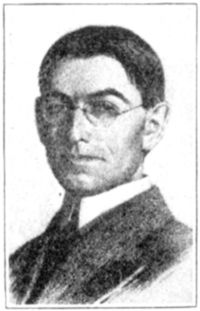
Hugh Pendexter

Hugh Pendexter

Summary

Portrait of Hugh Pendexter Hugh Pendexter Whittaker Burnham's Musicale (1907)

Then, as the true import flashed home to all three, they became galvanized into an intensity of motion and danced madly around the machine, calling encouragement into the horn, with the clerk trumpeting through his hands to make the singer hear; but the old man kneeling beside the prostrate woman heeded none of it.
"Hello, Bob! Hello! This is me! Don't ye know me?" implored the clerk, standing on one leg.
"And sweet Alice lies under the stone," the liquid voice replied.
"Bob! Bobbie! I say, Bob! Come out!" hoarsely begged the veteran, stumping his stiff leg to command attention.
Source: Wikisource

Portrait of Hugh Pendexter Hugh Pendexter Whittaker Burnham's Musicale (1907)

She blamed him and always would. Had the boy died, she would have remained the same loving helpmate. But now she was changed. He loved the boy, he told himself, and only God could know the washings his soul had received from useless tears, as in moments of privacy he gave way to his grief.
Source: Wikisource

Portrait of Hugh Pendexter Hugh Pendexter Whittaker Burnham's Musicale (1907)

Ever since their boy Bob ran away, ten years ago, she's been gloomy an' depressed like. Whittaker, close as he is, would buy anything ter rouse her up. But dang a talkin'-machine!"
"Yas," observed the stiff-legged veteran, who reveled in a local reputation of having supplied the brains behind every campaign in the Civil War; "they're mighty peculiar. I guess no one knows what they really be. I remember when Grant was askin' my advice about th' Wilderness——"
"A talkin'-machine is peculiar only in its disposition ter be cussed," amended the town clerk heavily. "They work simple enough.
Source: Wikisource

Get perspective with Kwize: daily news enlightened by great literature