Summary

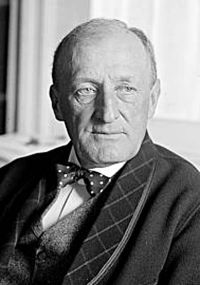
Portrait of James Clark McReynolds James Clark McReynolds Fullerton-Krueger Lumber Company v…

The petitioner maintains that Congress intended to revive actions against carriers when the period designated by the state statute for bringing them had expired during federal control, and asserts that the mischief to be remedied indicates such purpose and the ordinary meaning of the words employed discloses it. The respondent insists that a statute should never be given retroactive effect where another construction is fairly permissible, as here
Source: Wikisource

Portrait of James Clark McReynolds James Clark McReynolds Fullerton-Krueger Lumber Company v…

The Supreme Court of Minnesota held, rightly, we think, that the Transportation Act was not intended to revive or restore rights of action barred before it became effective.
'It is a rule of construction, that all statutes are to be considered prospective, unless the language is express to the contrary, or there is a necessary implication to that effect.' Harvey v.
Source: Wikisource

Portrait of James Clark McReynolds James Clark McReynolds Fullerton-Krueger Lumber Company v…

Tyler, 2 Wall. 328, 347 (17 L. Ed. 871) ; Sohn v. Waterson, 17 Wall. 596, 599, 21 L. Ed. 737; Twenty Per Cent. Cases, 20 Wall. 179, 187, 22 L. Ed. 339; Chew Heong v. United States, 112 U.S. 536, 559, 5 S.C.t. 255, 28 L. Ed. 770; Shwab v. Doyle, 258 U.S. 529, 534, 42 S.C.t. 391, 66 L. Ed. 747, 26 A. L. R. 1454. And see Hopkins v. Lincoln Trust Co., 233 N. Y. 213, 135 N. E. 267.
Applying this rule, we find no circumstances existing when the statute in question was enacted, nor any language therein, which shows that it should be applied to causes barred by limitation before its passage.
Source: Wikisource

Get perspective with Kwize: daily news enlightened by great literature