Summary

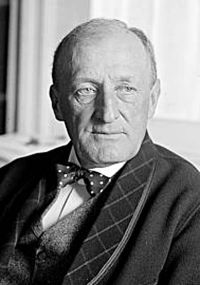
Portrait of James Clark McReynolds James Clark McReynolds Wilson v. Pacific Mail Steamship Company…

Big vessels may not insolently disregard smaller ones; supersize gives no right to domineer. The Newport was a handy vessel. By porting her helm or reversing her engines two minutes or less before the collision occurred she could have avoided it easily. There was nothing to show that she would not do one of these things until too late for the Svea's master to maneuver his vessel into safety.
Source: Wikisource

Portrait of James Clark McReynolds James Clark McReynolds Wilson v. Pacific Mail Steamship Company…

If the master of the preferred steamer were at liberty to speculate upon the possibility, or even of the probability, of the approaching steamer failing to do her duty and keep out of his way, the certainty that the former will hold his course, upon which the latter has a right to rely, and which it is the very object of the rule to insure, would give place to doubts on the part of the master of the obligated steamer as to whether he would do so or not, and produce a timidity and feebleness of action on the part of both, which would bring about more collisions than it would prevent.
Source: Wikisource

Portrait of James Clark McReynolds James Clark McReynolds Wilson v. Pacific Mail Steamship Company…

The applicable doctrine is plainly announced in The Delaware, 161 U.S. 459, 469, 16 S.C.t. 516, 521 (40 L. Ed. 771) :
'The cases of The Britannia, 153 U.S. 130 (14 S.C.t. 795, 38 L. Ed. 660) , and the Northfield, 154 U.S. 629 (Appx., 14 S. Ct. 1184, 24 L. Ed. 680) , must be regarded, however, as settling the law that the preferred steamer will not be held in fault for maintaining her course and speed, so long as it is possible for the other to avoid her by porting, at least in the absence of some distinct indication that she is about to fail in her duty.
Source: Wikisource

Get perspective with Kwize: daily news enlightened by great literature