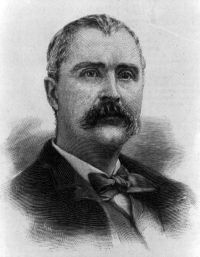
John Boyle O'Reilly

John Boyle O'Reilly

Summary

Portrait of John Boyle O'Reilly John Boyle O'Reilly Moondyne — The Iron-Stone Mountains (1879)

Tall, lithe, and powerful was the young bushman. He arose and leant on his handful of slender spears, speaking rapidly to Moondyne. Once he glanced at the sergeant, and, smiling, pointed to the still quivering spear in the tuad. Then he turned and led them up the valley, which soon narrowed to the dimensions of a ravine, like the bed of a torrent, running its perplexed way between overhanging walls of iron-stone.
Source: Wikisource

Portrait of John Boyle O'Reilly John Boyle O'Reilly Moondyne — The Iron-Stone Mountains (1879)

A dozen determined men could hold such a pass against an army. Above their heads the travellers saw a narrow slit of sky, sprinkled with stars. The air was damp and chill between the precipitous walls. The dismal pass was many miles in length; but at last the glare of a fire lit up the rocks ahead.
The young bushman went forward alone, returning in a few minutes. Then Moondyne and the sergeant, proceeding with him to the end of the pass, found themselves in the opening of a small valley or basin, over which the sky, like a splendid domed roof, was clearly rounded by the tops of the mountains.
Source: Wikisource

Portrait of John Boyle O'Reilly John Boyle O'Reilly Moondyne — The Iron-Stone Mountains (1879)

The punishment of falsehood is to suspect all truth. The mean of soul cannot conceive nobility. The vicious cannot believe in virtue. The artificial dignity imparted by the sergeant's office had disappeared, in spite of himself; and in its place returned the caitiff aspect that had marked him when he was a convict and a settler. Standing on an equality with Moondyne, their places had changed, and the prisoner was the master.
Source: Wikisource

Get perspective with Kwize: daily news enlightened by great literature