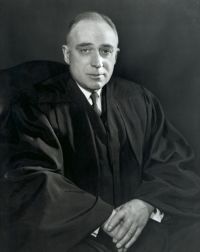
John Marshall Harlan II

John Marshall Harlan II

Summary

Portrait of John Marshall Harlan II John Marshall Harlan II Gray v. Sanders — Dissent

At the core of Georgia's diffusion of voting strength which favors the small as against the large counties is the urban-rural problem, so familiar in the American political scene. In my dissent in Baker v. Carr, 369 U.S., at 336, 82 S.Ct., at 774, I expressed the view that a State might rationally conclude that its general welfare was best served by apportioning more seats in the legislature to agricultural communities than to urban centers, lest the legitimate interests of the former be submerged in the stronger electoral voice of the latter.
Source: Wikisource

Portrait of John Marshall Harlan II John Marshall Harlan II Gray v. Sanders — Dissent

Surely, if the Court's 'one person, one vote' ideology is constitutionally untenable, as I think it clearly is, the basic ground rules implementing Baker v. Carr should await the trial of this or some other case in which we have before us a fully developed record. Only then can we know what we are doing. Cf. White Motor Co. v. United States, 372 U.S. 253, 83 S.Ct. 696. A matter which so profoundly touches the barriers between federal judicial and state legislative authority demands nothing less.
I would vacate the judgment of the District Court and remand the case for trial.
Source: Wikisource

Portrait of John Marshall Harlan II John Marshall Harlan II Gray v. Sanders — Dissent

The Fifteenth Amendment simply assures that the right to vote shall not be impaired 'on account of race, color, or previous condition of servitude.' The Seventeenth Amendment provides that Senators shall be 'elected by the people,' with no indication that all people must be accorded a vote of equal weight. The Nineteenth Amendment merely gives the vote to women.
Source: Wikisource

Get perspective with Kwize: daily news enlightened by great literature