Summary

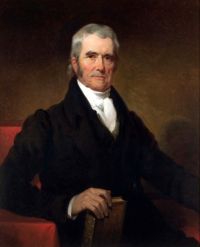
Portrait of John Marshall John Marshall Royal Naval Biography — Guion, Gardiner Henry (1823)

About half an hour afterwards, the Repulse also commenced firing her stern guns; but finding that the shot of the frigates were passing over the Philomel, Captain Halliday instantly bore up to keep astern of her, and treated them with so heavy and well-directed a fire, that, in the course of a quarter of an hour, they wore, and joined the line-of-battle ships, several of which were also, by this time, far advanced in the chase.
Source: Wikisource

Portrait of John Marshall John Marshall Royal Naval Biography — Guion, Gardiner Henry (1823)

Our boats were eight in number, and the enemy’s nine; our’s armed in the usual way, their’s more formidable, all of them being gun-boats, each carrying a 12-pounder carronade and 6 swivels, and rowing from 20 to 30 oars.
“Lieutenant Guion, who directed the operations, made a feint of retreating, to decoy the enemy from their shore defences, when suddenly turning on them, they fled. The barge of this ship, in which he was, being the fleetest boat, advanced most gallantly along the rear of the enemy’s line to their third boat
Source: Wikisource

Portrait of John Marshall John Marshall Royal Naval Biography — Guion, Gardiner Henry (1823)

The gun-boat taken by Lieutenant Guion had 2 killed and 3 wounded; amongst the latter was her commander, severely. The vessels alluded to above were then burnt.
(Signed) “Joseph S. Yorke.” Lieutenant Guion was made a commander, and appointed to the Philomel brig of 18 guns, on the Mediterranean station. May 17, 1810. On the 31st Aug. following, that vessel was chased by a French squadron, off Toulon, and rescued in the most noble manner by the Repulse 74, Captain John Halliday, now Rear-Admiral Tollemache.
Source: Wikisource

Get perspective with Kwize: daily news enlightened by great literature