Summary

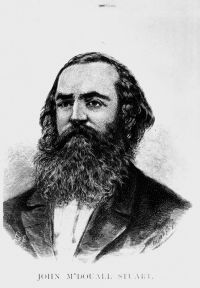
Portrait of John McDouall Stuart John McDouall Stuart South Australia: Exploring Expedition Into the Interior of the Continent (1860)

Much consideration had led him to think that the surface-formation of Australia was something like a great crater; that the high lands all round the coast threw off but short watercourses to the sea, and had a drainage into the interior, forming a great inland sea, of which the wastepipe was, at some previous period, Lake Torrens and Spencer Gulf, by which the whole of the waters, or the greater part, found their way into the ocean. This opening formed the gate, he conceived, by which we must hope to penetrate into the interior, and by which the produce of the country must come down.
Source: Wikisource

Portrait of John McDouall Stuart John McDouall Stuart South Australia: Exploring Expedition Into the Interior of the Continent (1860)

So much was he struck by these facts that long before Sturt penetrated into the desert to the east of Lake Torrens, he had marked the spot on the map as the centre of a burning sandy desert. Sturt found it so; his thermometers blew up with the heat, and his pork melted in the bran in which it was packed. This verification of his opinion as to the nature of the country eastward gave him increased confidence in his opinion of the country westward.
Source: Wikisource

Portrait of John McDouall Stuart John McDouall Stuart South Australia: Exploring Expedition Into the Interior of the Continent (1860)

Colonel Gawler, F.R.G.S., said that he could easily conceive that men of the highest science should be led to the conclusion that the whole interior of Australia was a waterless and impassable desert. He had had opportunities of forming an opinion from local observations, and he was gratified to find that they were being borne out by the present discoveries from the head of Spencer Gulf in the direction of the north-west coast.
Source: Wikisource

Get perspective with Kwize: daily news enlightened by great literature