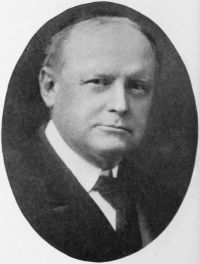
 John Punnett Peters,
1911 Encyclopædia Britannica, Volume 9…
(1911)
John Punnett Peters,
1911 Encyclopædia Britannica, Volume 9…
(1911)
“ The ruins of the ancient site, known as Warka, which are among the largest in all Babylonia, forming an irregular circle nearly 6 m. in circumference, bounded by a wall, still standing in some places to the height of 40 ft., were explored and partially excavated by W. K. Loftus in 1850 and 1854. The most conspicuous ruin, now called Abu-Berdi, “Father of Marsh Grass,” or Buwariye, “reed matting,” because of the layers of reeds between each twelve courses of unbaked brick, is the ziggurat (tower) of the ancient temple of E-Anna. It is about 100 ft. ”
