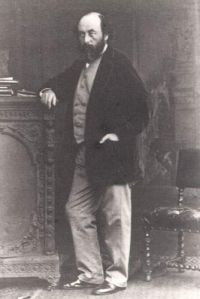
Joseph Beete Jukes

Joseph Beete Jukes

Summary

Portrait of Joseph Beete Jukes Joseph Beete Jukes The South Staffordshire Coalfield… (1859)

A single example will suffice. Suppose a section be drawn running north-east and south-west, and it crosses certain beds dipping north at 35° (or certain cleavage planes, or a vein, or a fault, or any other plane having that dip) , what angle ought we give to those beds in the section in order to give a true representation of the apparent dip they would have in a cliff running parallel to the section? In this case the angle between the direction of the dip and that of the section, or between north and north-east = 45°
Source: Wikisource

Portrait of Joseph Beete Jukes Joseph Beete Jukes The South Staffordshire Coalfield… (1859)

In speaking of the inclination of a bed, or of a fault, or any other plane, it is common in South Staffordshire to describe it by saying how many inches it deepens, or dips, in a yard. In many other districts this is done by saying how many feet or yards it dips or inclines in Geologists usually describe the dip by stating the number of degrees of the angle included between the plane of the bed, &c.
Source: Wikisource

Get perspective with Kwize: daily news enlightened by great literature