Summary

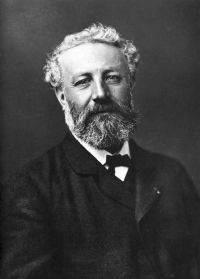
Portrait of Jules Verne Jules Verne From the Earth to the Moon — Chapter V

If the observer had then specially directed his attention to one of the more humble and less brilliant of these stellar bodies, a star of the fourth class, that which is arrogantly called the Sun, all the phenomena to which the formation of the Universe is to be ascribed would have been successively fulfilled before his eyes. In fact, he would have perceived this sun, as yet in the gaseous state, and composed of moving molecules, revolving round its axis in order to accomplish its work of concentration.
Source: Wikisource

Portrait of Jules Verne Jules Verne From the Earth to the Moon — Chapter V

An observer endued with an infinite range of vision, and placed in that unknown center around which the entire world revolves, might have beheld myriads of atoms filling all space during the chaotic epoch of the universe. Little by little, as ages went on, a change took place; a general law of attraction manifested itself, to which the hitherto errant atoms became obedient: these atoms combined together chemically according to their affinities, formed themselves into molecules, and composed those nebulous masses with which the depths of the heavens are strewed.
Source: Wikisource

Get perspective with Kwize: daily news enlightened by great literature