Summary

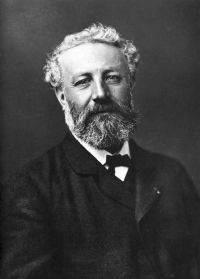
Portrait of Jules Verne Jules Verne From the Earth to the Moon — Chapter VI

To those who were not familiar with the motions of the moon, they demonstrated that she possesses two distinct motions, the first being that of rotation upon her axis, the second being that of revolution round the earth, accomplishing both together in an equal period of time, that is to say, in twenty-seven and one-third days.
The motion of rotation is that which produces day and night on the surface of the moon; save that there is only one day and one night in the lunar month, each lasting three hundred and fifty-four and one-third hours.
Source: Wikisource

Portrait of Jules Verne Jules Verne From the Earth to the Moon — Chapter VI

However, they became reassured as to the fate of future generations on being apprised that, according to the calculations of Laplace, this acceleration of motion is confined within very restricted limits, and that a proportional diminution of speed will be certain to succeed it. So, then, the stability of the solar system would not be deranged in ages to come.
There remains but the third class, the superstitious. These worthies were not content merely to rest in ignorance; they must know all about things which had no existence whatever, and as to the moon, they had long known all about her.
Source: Wikisource

Get perspective with Kwize: daily news enlightened by great literature