Summary

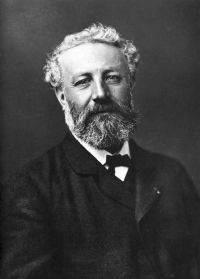
Portrait of Jules Verne Jules Verne Journey into the Interior of the Earth… (1877)

Its body —dusky, enormous, hillocky — lies spread upon the sea like an islet. Is it illusion or fear? Its length seems to me a couple of thousand yards. What can be this cetacean, which neither Cuvier nor Blumenbach knew anything about? It lies motionless, as if asleep; the sea seems unable to move it in the least; it is the waves that undulate upon its sides. The column of water thrown up to a height of five hundred feet falls in rain with a deafening uproar. And here are we scudding like lunatics before the wind, to get near to a monster that a hundred whales a day would not satisfy!
Source: Wikisource

Portrait of Jules Verne Jules Verne Journey into the Interior of the Earth… (1877)

The islet resembles, with a most deceiving likeness, an enormous cetacean, whose head dominates the waves at a height of twenty yards. The geyser, a word meaning 'fury,' rises majestically from its extremity. Deep and heavy explosions are heard from time to time, when the enormous jet, possessed with more furious violence, shakes its plumy crest, and springs with a bound till it reaches the lowest stratum of the clouds. It stands alone.
Source: Wikisource

Portrait of Jules Verne Jules Verne Journey into the Interior of the Earth… (1877)

At any rate, some leagues to the windward there must be some noisy phenomenon, for now the roarings are heard with increasing loudness. Do they proceed from the sky or the ocean?
I look up to the atmospheric vapours, and try to fathom their depths. The sky is calm and motionless. The clouds have reached the utmost limit of the lofty vault, and there lie still bathed in the bright glare of the electric light. It is not there that we must seek for the cause of this phenomenon.
Source: Wikisource

Get perspective with Kwize: daily news enlightened by great literature