Summary

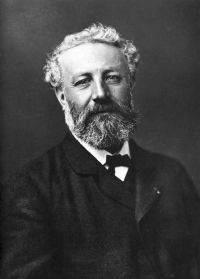
Portrait of Jules Verne Jules Verne,  Mathias Sandorf — Part II, Chapter V (1885)

“ But this is what I have to say to complete my story:
“You remained a widow with a boy of eight, almost penniless. Borik, the servant of Count Zathmar, would not leave you after his master's death; but he was poor, and had only his devotion to offer you.”
“Then, madame, you left Trieste for this humble dwelling at Ragusa. You have worked, worked with your hands to earn sufficient for your material as well as your mental needs. You wished, in fact, that your son should follow in science the path that his father had made illustrious.
”
Source: Wikisource

Portrait of Jules Verne Jules Verne,  Mathias Sandorf — Part II, Chapter V (1885)

“ The doctor, desirous of avoiding a meeting, turned quickly back, and did not resume his journey until the carriage had disappeared at the end of Stradone.
“Both in the same town!” he murmured. “This is chance; it is not my fault.”
Narrow, steep, badly paved, and of poor appearance are the roads which open on to the left of the Stradone. Imagine a large river with the tributaries on one of its sides all mountain torrents! To secure a little air the houses cluster on the hill-side one above the other and touch one another.
”
Source: Wikisource

Portrait of Jules Verne Jules Verne,  Mathias Sandorf — Part II, Chapter V (1885)

“ And as he spoke the doctor rose, and a shade of emotion just made itself visible despite his habitual reserve.
Mme. Bathory had nothing to say in reply. She waited, not knowing if the doctor had finished, or if he was going on to relate such facts as were personally known to him, and concerning which she had asked for the interview.
“However, madame,” continued the doctor, divining her thoughts, “human strength has doubtless its limits, and as you fell ill and exhausted with such trials you would doubtless have succumbed if an unknown—no, a friend of Professor Bathory—had not come to your aid.
”
Source: Wikisource

Get perspective with Kwize: daily news enlightened by great literature