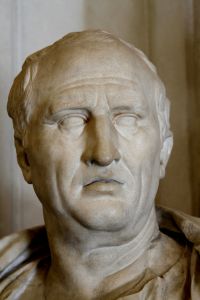
Marcus Tullius Cicero

Marcus Tullius Cicero

Summary

Portrait of Marcus Tullius Cicero Marcus Tullius Cicero Letters to Atticus — 2.24 (L)

Cicero, then, would have us believe that Vettius had been instigated by Vatinius (acting for Caesar) to name Bibulus, L. Lucullus, Curio (father and son) , L. Domitius Ahenobarbus, L. Lentulus, L. Paullus, Cicero himself, his son-in-law Piso, and M. Laterensis, as having been all more or less privy to the plot to murder Pompey and Caesar. That there was absolutely no such plot, and that Vettius broke down hopelessly when questioned. That the object was, (1) to irritate Pompey with the Optimates and so confirm him in his alliance with Caesar, (2) to discredit the Optimates generally.
Source: Wikisource

Portrait of Marcus Tullius Cicero Marcus Tullius Cicero Letters to Atticus — 2.24 (L)

Vettius, with a drawn dagger, rushed into the crowd crying out that he had been sent by Bibulus, Cicero, and Cato to assassinate Caesar and Pompey, and that an attendant of Bibulus had given him the dagger. Vettius was arrested, put into prison to be questioned the next day, and was murdered during the night. Caesar meanwhile addressed the people and excited their anger
Source: Wikisource

Portrait of Marcus Tullius Cicero Marcus Tullius Cicero Letters to Atticus — 2.24 (L)

The interest attaching to such a sordid person is confined to the question whether he was really acting with the connivance of, or under an agreement with, any of the leading politicians of the day. If the principle of cui bono is applied, it is evident that the gainers were the party of the trumvirs, whose popularity would be increased by a belief being created that their opponents the Optimates were prepared to adopt extreme measures to get rid of them.
Source: Wikisource

Get perspective with Kwize: daily news enlightened by great literature