Summary

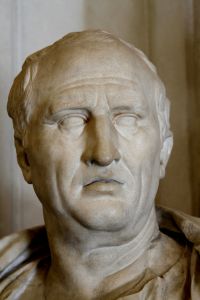
Portrait of Marcus Tullius Cicero Marcus Tullius Cicero Letters to Atticus — 3.8 (LXIII)

For by whose unprincipled advice I was egged on and betrayed you certainly now perceive, [5] and oh that you had perceived it before, and had not given your whole mind to lamentation along with me! Wherefore, when you are told that I am prostrate and unmanned with grief, consider that I am more distressed at my own folly than at the result of it, in having believed a man whom I did not think to be treacherous. My writing is impeded both by the recollection of my own disasters, and by my alarm about my brother. Yes, pray look after and direct all the affairs you mention.
Source: Wikisource

Portrait of Marcus Tullius Cicero Marcus Tullius Cicero Letters to Atticus — 3.8 (LXIII)

I comprehend from your letter what you and Pompey have been saying. That any movement in politics is impending I cannot see as clearly as you either see, or perhaps only suggest for my consolation. For, as the Case of Tigranes was passed over, all hope of a rupture is at an end. [2] You bid me thank Varro: I will do so; also Hypsaeus. [3] As to your advice not to go farther off till the acta [4] of the month of May reach me, I think I shall do as you suggest. But where to stay?
Source: Wikisource

Portrait of Marcus Tullius Cicero Marcus Tullius Cicero Letters to Atticus — 3.8 (LXIII)

Terentia expresses the warmest gratitude to you. I have sent you a copy of the letter which I have written to Pompey. Thessalonica, 29 May.
Footnotes ↑ Reading ab Ilio with Madvig for ab illo.↑ Tigranes, a son of the king of Armenia, was brought to Rome by Pompey to adorn his triumph, and put under the care of Lucius Flavius. This prince was, for a bribe, released by Clodius by a trick, and the attempt to get him away led to a scuffle in which lives were lost. Pompey regarded this as a slight upon himself, and his partisan, the consul Gabinius, attempted to prevent it.
Source: Wikisource

Get perspective with Kwize: daily news enlightened by great literature