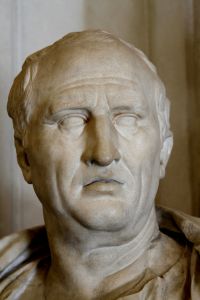
Marcus Tullius Cicero

Marcus Tullius Cicero

Summary

Portrait of Marcus Tullius Cicero Marcus Tullius Cicero On the Republic (1829)

Believing that it cannot but excite a deep interest with generous minds, as well on account of the high nature of the subject, the illustrious name of Cicero, as of the great motives which led him to compose this work, I venture to offer a translation of it to the public.
In this extensive republic, where every individual reads, it appears peculiarly proper, that an English dress should be given to a work, of which almost every page teaches that public happiness depends upon individual virtue.
Source: Wikisource

Portrait of Marcus Tullius Cicero Marcus Tullius Cicero On the Republic (1829)

Humbly as the translation may deserve to be considered, it will perhaps be deemed sufficiently faithful: and that the translator has not altogether failed in pointing out to grave and reflecting minds, the immediate cause of the ruin of a noble Republic.
He has therefore prefixed a brief historical introduction; the which, whether it will be thought too long, or not sufficiently detailed, will probably depend upon the reader’s historical recollections. The motive for drawing it up was to render the work more generally useful and acceptable.
CONTENTS
The Republic of Cicero.
Source: Wikisource

Portrait of Marcus Tullius Cicero Marcus Tullius Cicero On the Republic (1829)

By G. W. Featherstonhaugh, Esq., Fellow of the Geological Society of London; of the American Philosophical Society; of the Lyceum of Natural History of New-York, &c. &c. &c.”
In conformity to the Act of Congress of the United States, entitled, “An Act for the encouragement of learning, by securing the copies of maps, charts, and books, to the authors and proprietors of such copies, during the times therein mentioned;”
Source: Wikisource

Get perspective with Kwize: daily news enlightened by great literature