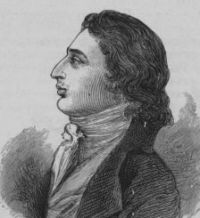
Robert Southey

Robert Southey

Summary

Portrait of Robert Southey Robert Southey Poems — Mary (1799)

When the sound of a voice seem'd to rise on her ear,
She paus'd, and she listen'd, all eager to hear,
And her heart panted fearfully now.
XV.
The wind blew, the hoarse ivy shook over her head,
She listen'd,—nought else could she hear,
The wind ceas'd, her heart sunk in her bosom with dread
For she heard in the ruins distinctly the tread
Of footsteps approaching her near.
Source: Wikisource

Portrait of Robert Southey Robert Southey Poems — Mary (1799)

They listen'd to hear the wind roar.
VII.
"'Tis pleasant," cried one, "seated by the fire side
"To hear the wind whistle without."
"A fine night for the Abbey!" his comrade replied,
"Methinks a man's courage would now be well tried
"Who should wander the ruins about.
Source: Wikisource

Portrait of Robert Southey Robert Southey Poems — Mary (1799)

The story of the following ballad was related to me, when a school boy, as a fact which had happened in the North of England. I have adopted the metre of Mr. Lewis's Alonzo and Imogene—a poem deservedly popular. The ballad, however little valuable in itself, derives a value now from having been made the subject of one of Mr. Barker's pictures.
MARY.
I.
Who is she, the poor Maniac, whose wildly-fix'd eyes
Seem a heart overcharged to express?
She weeps not, yet often and deeply she sighs:
She never complains, but her silence implies
The composure of settled distress.
Source: Wikisource

Get perspective with Kwize: daily news enlightened by great literature