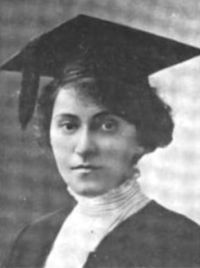
Ruth Edna Kelley

Ruth Edna Kelley

Summary

Portrait of Ruth Edna Kelley Ruth Edna Kelley The Book of Hallowe'en — XV. (1919)

For the centerpiece of the table there may be a hollowed pumpkin,
filled with apples and nuts and other fruits of harvest, or
a pumpkin-chariot drawn by field-mice. So it is clear that this
is a harvest-party, like Pomona's feast. In the coach rides a
witch, representing the other element, of magic and prophecy.
Jack-o'-lanterns, with which the room is lighted, are hollowed
pumpkins with candles inside. The candle-light shines through holes
cut like features. So the lantern becomes a bogy, and is held up at
a window to frighten those inside.
Source: Wikisource

Portrait of Ruth Edna Kelley Ruth Edna Kelley The Book of Hallowe'en — XV. (1919)

Such sports mean no more at Hallowe'en than the
tricks played the night before the Fourth of July have to do with
the Declaration of Independence. We see manifested on all such
occasions the spirit of "Free-night" of which George von Hartwig
speaks so enthusiastically in St. John's Fire (page 141) .
Hallowe'en parties are the real survival of the ancient merrymakings.
They are prepared for in secret. Guests are not to divulge the fact
that they are invited. Often they come masked, as ghosts or witches.
Source: Wikisource

Portrait of Ruth Edna Kelley Ruth Edna Kelley The Book of Hallowe'en — XV. (1919)

And dis is das de night for de witches, sho!
Dey's trouble going to waste when de ole slut whine,
An' you hear de cat a-spittin' when de moon don't shine."
RILEY: When de Folks is Gone.
While the original customs of Hallowe'en are being forgotten more
and more across the ocean, Americans have fostered them, and are
making this an occasion something like what it must have been in
its best days overseas. All Hallowe'en customs in the United States
are borrowed directly or adapted from those of other countries.
Source: Wikisource

Get perspective with Kwize: daily news enlightened by great literature