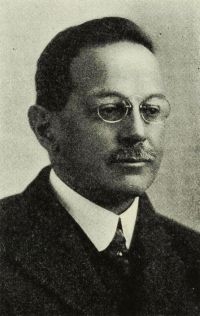
Samuel Scoville, Jr.

Samuel Scoville, Jr.

Summary

Portrait of Samuel Scoville, Jr. Samuel Scoville, Jr. The Inca Emerald — III The Vampires (1922)

Jud was more impressed with the wonders of the vegetable kingdom. Whenever he strayed off the beaten path or tried to cut his way through a thicket, he tangled himself in the curved spines of the pull-and-haul-back vine, a thorny shrub which lives up to its name, or was stabbed by the devil-plant, a sprawling cactus which tries quite successfully to fill up all the vacant spaces in the jungle where it grows.
Source: Wikisource

Portrait of Samuel Scoville, Jr. Samuel Scoville, Jr. The Inca Emerald — III The Vampires (1922)

Deep in the jungle, they at last came to a little open stretch where the Professor had often collected before and which to-day seemed full of butterflies. Never had Will imagined such a riot of color and beauty as there dazzled his eyes. Some of the butterflies were red and yellow, the colors of Spain. Others were green, purple, and blue, bordered and spangled with spots of silver and gold. Then there were the strange transparent "glass-wings." One of these, the Hetaira esmeralda, Will was convinced must be the most beautiful of all flying creatures.
Source: Wikisource

Portrait of Samuel Scoville, Jr. Samuel Scoville, Jr. The Inca Emerald — III The Vampires (1922)

In and out of this buzzed a cloud of bees.
"I get you!" shouted Jud, much delighted, "a bee-tree! Look out, boy," he went on, as the Indian, clinging to the ridges of the bark with his fingers and toes, began to climb. "Those bees'll sting you to death."
"South American bees hab no sting," explained Hen, as Pinto reached the wax spout, and, breaking it off, thrust his hand fearlessly through the cloud of bees into the store of honey beyond.
Source: Wikisource

Get perspective with Kwize: daily news enlightened by great literature