Summary

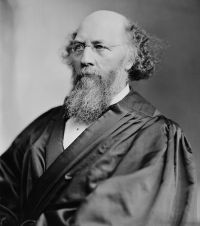
Portrait of Stephen Johnson Field Stephen Johnson Field Sheets v. Selden's Lessee — Opinion of the Court

In such cases the State alone is bound by the deed or contract, and can alone claim its benefits. [1]
The objection that the deed does not cover the premises in controversy rests upon the fact that it does not convey the parcels of land for which the action is brought, by specific designation and description. Such designation and desciption, though usual, are not always essential. Land will often pass by other terms. Thus a grant of a messuage or a messuage with the appurtenances will carry the dwelling-house and adjoining buildings, and also its orchard, garden, and curtilage.
Source: Wikisource

Portrait of Stephen Johnson Field Stephen Johnson Field Sheets v. Selden's Lessee — Opinion of the Court

In the computation of the time, the day upon which the rent became due was to be excluded. The general current of the modern authorities on the interpretation of contracts, and also of statutes, where time is to be computed from a particular day or a particular event, as when an act is to be performed within a specified period from or after a day named, is to exclude the day thus designated, and to include the last day of the specified period.
Source: Wikisource

Portrait of Stephen Johnson Field Stephen Johnson Field Sheets v. Selden's Lessee — Opinion of the Court

Thus the devise of a mill and its appurtenances was held by Mr. Justice Story to pass to the devisee not merely the building but all the land under the mill and necessary for its use, and commonly used with it. [4] So a conveyance 'of a certain tenement, being one-half of a corn-mill situated,' on a designated lot 'with all the privileges and appurtenances' was held by the Supreme Court of New Hampshire to pass not only the mill, but the land on which it was situated, together with such portion of the water privilege as was essential to its use.
Source: Wikisource

Get perspective with Kwize: daily news enlightened by great literature