Summary

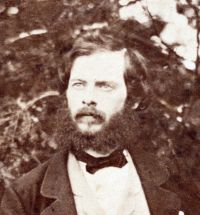
Portrait of Theodore Winthrop Theodore Winthrop Life in the Open Air — Chapter XIV. Homeward (1863)

An hour before sunset, Cancut steered us toward a beach, and pointed out a vista in the woods, evidently artificial, evidently a road trodden by feet and hoofs, and ruled by parallel wheels. A road is one of the kindliest gifts of brother man to man: if a path in the wilderness, it comes forward like a friendly guide offering experience and proposing a comrade dash deeper into the unknown world; if a highway, it is the great, bold, sweeping character with which civilization writes its autograph upon a continent.
Source: Wikisource

Portrait of Theodore Winthrop Theodore Winthrop Life in the Open Air — Chapter XIV. Homeward (1863)

He must be true and powerful.
The storm rolled by and gave us a noble view of Katahdin, beyond a broad, beautiful scope of water, and rising seemingly directly from it. We fled before another squall, over another breadth of Bammydumcook, and made a portage around a great dam below the lake. The world should know that at this dam the reddest, spiciest, biggest, thickest wintergreen-berries in the world are to be found, beautiful as they are good.
Birch had hitherto conducted himself with perfect propriety.
Source: Wikisource

Portrait of Theodore Winthrop Theodore Winthrop Life in the Open Air — Chapter XIV. Homeward (1863)

Leaving our plunder on the beach, beyond the reach of plunderers, whose great domain we were about to enter, we walked on toward the first house, compelled at parting to believe, that, though we did not love barbarism less, we loved civilization more. In the morning, Cancut should, with an ox-cart, bring Birch and our traps over the three miles of the carry.
Source: Wikisource

Get perspective with Kwize: daily news enlightened by great literature