Summary

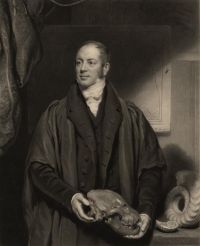
Portrait of William Buckland William Buckland On the Paramoudra, and Formation of Flints in Chalk (1817)

The present shape of many chalk flints being that of organic bodies, demonstrates the latter to have existed before the consolidation of the former; for the fidelity with which the silex has often copied the organization, and even the accidents and irregularities of the bodies enveloped, is so accurate, that it is impossible to attribute the form of the flint to any other cause than that of the body on which it was deposited. Sometimes the organization is so delicately retained, that it seems not to have undergone the smallest derangement before the siliceous cast was taken
Source: Wikisource

Portrait of William Buckland William Buckland On the Paramoudra, and Formation of Flints in Chalk (1817)

The solution of the latter question may be, that different genera of organic remains afforded centers that attracted the silex with unequal force, and that this will in some degree explain the phenomenon so common in the chalk formation, that bodies allied to the genus spunge and alcyonium, are most frequently preserved in flint and chalcedony, whilst shells and other bodies, which in their natural state were more calcareous, generally have their form retained by chalk or calcareous spar.
Source: Wikisource

Portrait of William Buckland William Buckland On the Paramoudra, and Formation of Flints in Chalk (1817)

I allude particularly to those agates in which there are no traces of any funnel through which the matter of the concentric zones could have been introduced; and to those chalcedonic geodes in the basalt of the Giant's Causeway, in which also no sign of a funnel can be discovered, but the component laminæ are disposed in parallel lines, crossing horizontally the cavity in which they are contained, and sometimes filling only the lower region of it.
Source: Wikisource

Get perspective with Kwize: daily news enlightened by great literature