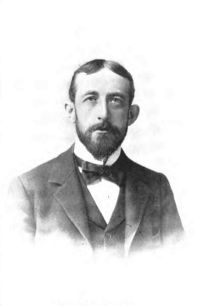
William Peterfield Trent

William Peterfield Trent

Summary

Portrait of William Peterfield Trent William Peterfield Trent The New International Encyclopædia (1905)

The Tennessee Legislature called for volunteers, and resolved to exterminate the troublesome tribe. In spite of the wound which Jesse Benton had given him, Jackson was soon in the field, and with Colonel Coffee, his former partner, defeated the Indians severely at Talladega and at Tohopeka or Horseshoe Bend on the Tallapoosa River. Jackson distinguished himself in these military operations by his boundless energy.
Source: Wikisource

Portrait of William Peterfield Trent William Peterfield Trent The New International Encyclopædia (1905)

It is not certain what means of support he had, but after working a while at the saddler's trade, in 1784 he began to study law at Salisbury, N. C. He was a rollicking fellow, fond of horse-racing and cock-fighting, and no student, having taken up law, about which he never learned much, because it was the accepted thing for a young man to do who had some ambition.
Source: Wikisource

Portrait of William Peterfield Trent William Peterfield Trent The New International Encyclopædia (1905)

In April, 1815, Jackson was appointed commander-in-chief of the Southern Division, and Congress voted thanks for his services. His next active work was in the war against the Seminoles in Florida, in the course of which occurred another of his acts which created no little excitement. He arrested and put to death, on the charge of inciting the Indians, two British subjects, an English adventurer, Ambrister, who was not proved guilty, and a Scotch trader, Arbuthnot, who seems to have been innocent.
Source: Wikisource

Get perspective with Kwize: daily news enlightened by great literature