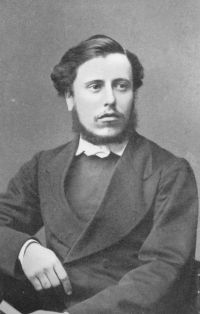
William Robertson Smith

William Robertson Smith

Summary

Portrait of William Robertson Smith William Robertson Smith 1911 Encyclopædia Britannica, Volume 18… (1911)

The houses are good stone buildings similar in style to those of Mecca; the streets are narrow but clean, and in part paved. [5] There is a copious supply of water conducted from a tepid source (ez-Zarkā) at the village of Kuba, 2 m. south, and distributed in underground cisterns in each quarter. [6] The glory of Medina, and the only important building, is the mosque of the Prophet, in the eastern part of the city, a spacious enclosed court between 400 and 500 ft.
Source: Wikisource

Portrait of William Robertson Smith William Robertson Smith 1911 Encyclopædia Britannica, Volume 18… (1911)

Thirty or forty families with their cattle occupy a single courtyard (ḥōsh) , and form a kind of community often at feud with its neighbours. The several clans of Medina must have lived in much the same way at the time of the Prophet. The famous cemetery called Baḳīʽ el-Gharḳad, the resting-place of a multitude of the “companions” of the Prophet, lies immediately to the west of the city.
Source: Wikisource

Portrait of William Robertson Smith William Robertson Smith 1911 Encyclopædia Britannica, Volume 18… (1911)

Thus situated, Medina was originally a city of agriculturists, not like Mecca a city of merchants; nor, apart from the indispensable trade in provisions, has it ever acquired commercial importance like that which Mecca owes to the pilgrimage. [2] Landowners and cultivators are still a chief element in the population of the city and suburbs. The latter, who are called Nakhāwila, and more or less openly profess the Shī‛a opinions, marry only among themselves. The townsmen proper, on the other hand, are a very motley race. [3] New settlers remain behind with each pilgrimage
Source: Wikisource

Get perspective with Kwize: daily news enlightened by great literature