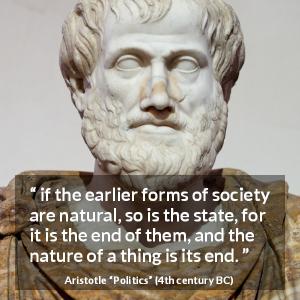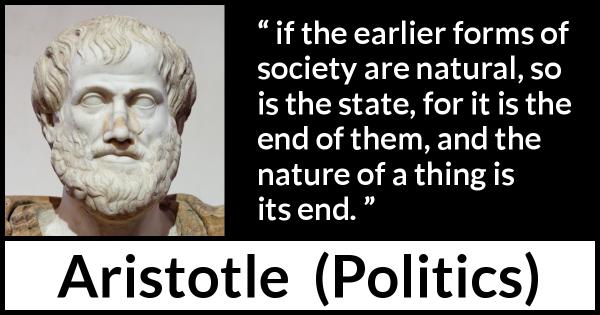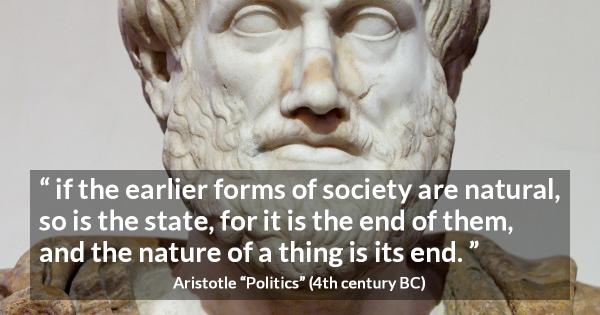


“ if the earlier forms of society are natural, so is the state, for it is the end of them, and the nature of a thing is its end. ”
Aristotle, Politics (4th century BC). copy citation
| Author | Aristotle |
|---|---|
| Source | Politics |
| Topic | nature state |
| Date | 4th century BC |
| Language | English |
| Reference | |
| Note | Translated by Benjamin Jowett |
| Weblink | http://classics.mit.edu/Aristotle/politics.html |
Context
“When several villages are united in a single complete community, large enough to be nearly or quite self-sufficing, the state comes into existence, originating in the bare needs of life, and continuing in existence for the sake of a good life. And therefore, if the earlier forms of society are natural, so is the state, for it is the end of them, and the nature of a thing is its end. For what each thing is when fully developed, we call its nature, whether we are speaking of a man, a horse, or a family. Besides, the final cause and end of a thing is the best, and to be self-sufficing is the end and the best.”
source
Meaning and analysis