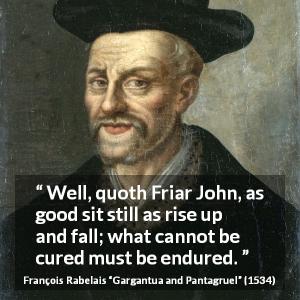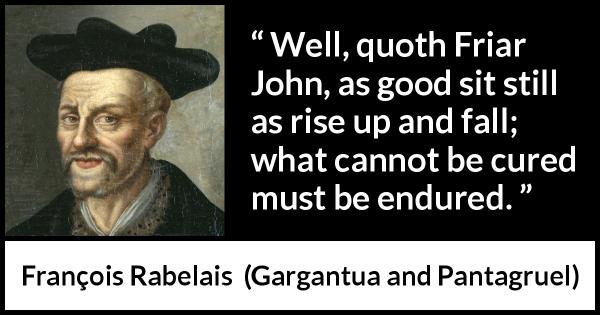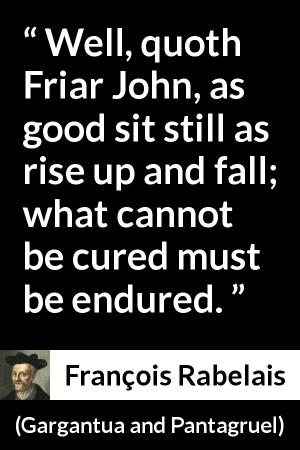


“ Well, quoth Friar John, as good sit still as rise up and fall; what cannot be cured must be endured. ”
François Rabelais, Gargantua and Pantagruel (1534). copy citation
| Author | François Rabelais |
|---|---|
| Source | Gargantua and Pantagruel |
| Topic | suffering cure |
| Date | 1534 |
| Language | English |
| Reference | |
| Note | Translated by Sir Thomas Urquhart of Cromarty and Peter Antony Motteux |
| Weblink | http://www.gutenberg.org/files/1200/1200-h/1200-h.htm |
Context
“Was Ulysses so mad as to go back into the Cyclop's cave to fetch his sword? No, marry was he not. Now I have left nothing behind me at the wicket through forgetfulness; why then should I think of going thither?
Well, quoth Friar John, as good sit still as rise up and fall; what cannot be cured must be endured. But, prithee, let's hear one another speak. Come, wert thou not a wise doctor to fling away a whole purse of gold on those mangy scoundrels? Ha! A squinsy choke thee! we were too rich, were we? Had it not been enough to have thrown the hell-hounds a few cropped pieces of white cash?” source
Well, quoth Friar John, as good sit still as rise up and fall; what cannot be cured must be endured. But, prithee, let's hear one another speak. Come, wert thou not a wise doctor to fling away a whole purse of gold on those mangy scoundrels? Ha! A squinsy choke thee! we were too rich, were we? Had it not been enough to have thrown the hell-hounds a few cropped pieces of white cash?” source
Meaning and analysis