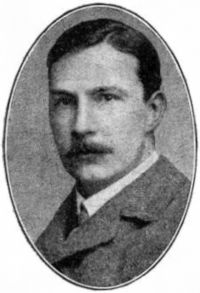
Andrew H. Frost and Charles A. M. Fennell

Biographical details

Andrew H. Frost and Charles A. M. Fennell 1911 Encyclopædia Britannica, Volume 17… (1911)

MAGIC SQUARE, a square divided into equal squares, like a chess-board, in each of which is placed one of a series of consecutive numbers from 1 up to the square of the number of cells in a side, in such a manner that the sum of the numbers in each row or column and in each diagonal is constant.
Fig. 1. From a very early period these squares engaged the attention of mathematicians, especially such as possessed a love of the marvellous, or sought to win for themselves a superstitious regard.
Source: Wikisource

Andrew H. Frost and Charles A. M. Fennell 1911 Encyclopædia Britannica, Volume 17… (1911)

From a perfect magic ring of n2 cells containing one number each, n2 distinct magic squares can be read off; as the four numbers round each intersection of a zonal circle and a transverse circle constitute corner numbers of a magic square. The shape of a magic ring gives it the function of an indefinite extension in all directions of each of the aforesaid n2 magic squares.
Source: Wikisource

Andrew H. Frost and Charles A. M. Fennell 1911 Encyclopædia Britannica, Volume 17… (1911)

Nasik Cubes.—A Nasik cube is composed of n3 small equal cubes, here called cubelets, in the centres of which the natural numbers from 1 to n3 are so placed that every section of the cube by planes
Fig. 25—Nasik Cube. perpendicular to an edge has the properties of a Nasik square; also sections by planes perpendicular to a face, and passing through the cubelet centres of any path of Nasical summation in that face. Fig. 25 shows by dots the way in which these cubes are constructed.
Source: Wikisource

Get perspective with Kwize: daily news enlightened by great literature