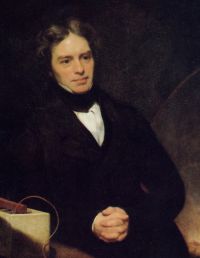
Augustin Privat-Deschanel

Biographical details

Augustin Privat-Deschanel,  Popular Science Monthly (1873)

“ The early inventors of electric telegraphs supposed that a current could not be sent from one station to another without a return-wire to complete the circuit. Steinheil, while conducting experiments on a railway, with the view of ascertaining whether the rails could be employed as lines of telegraph, made the discovery that the earth would serve instead of a return-wire, and with the advantage of diminished resistance; the earth, in fact, behaving like a return-wire of infinitely great cross-section, and therefore of no resistance. ”
Source: Wikisource

Augustin Privat-Deschanel,  Popular Science Monthly (1873)

“ Hughes, about 1859, invented a system which requires only one current to be sent for each letter, and which, accordingly, sends messages in about a third of the time required by Morse's method. Hughes's machine also prints its messages in Roman characters on a strip of paper. These advantages are, however, obtained at the expense of extreme complexity in the apparatus employed. It is only fit for the use of skilled hands; but it is extensively employed on important lines of telegraph. ”
Source: Wikisource

Augustin Privat-Deschanel,  Popular Science Monthly (1873)

“ The current traverses the coils of an electro-magnet (E, Fig. 13) , beneath which is a permanent steel horseshoe magnet, having its poles in contact with the soft-iron cores of the electro-magnet. When no current is passing, the influence of the steel renders these cores temporary magnets, and enables them to hold the movable armature (p) against the force of an opposing spring. The current is in such a direction that it tends to reverse the magnetism induced by the steel. ”
Source: Wikisource

Get perspective with Kwize: daily news enlightened by great literature