
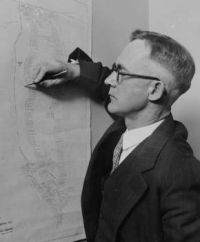
 Elmer Drew Merrill,
Proceedings of the Linnean Society of New South Wales
(1919)
Elmer Drew Merrill,
Proceedings of the Linnean Society of New South Wales
(1919)
“ This corresponds to about 0.33 per cent. of sodium chloride, which is a high percentage for a soil, and is quite sufficient to account for the large proportion of soda and chlorine in the Mallee root-water. Not all samples of sap obtained in the manner of the Mallee root-water are so dilute; Smith, for instance, [4] found enormously greater amounts of both mineral and organic solids in the sap from the timber of Grevillea robusta, while the juices of such plants as the sugar-cane and sugar-maple, carry large percentages of sugar, though not of mineral constituents ”
