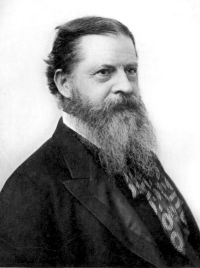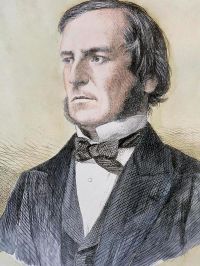
George Boole

Biographical details

Portrait of George Boole George Boole,  The calculus of logic (1848)

“ Undoubtedly the final aim of speculative logic is to assign the conditions which render reasoning possible, and the laws which determine its character and expression. The general axiom (A) and the laws (1) , (2) , (3) , appear to convey the most definite solution that can at present be given to this question. When we pass to the consideration of hypothetical propositions, the same laws and the same general axiom which ought perhaps also to be regarded as a law, continue to prevail ”
Source: Gutenberg

Portrait of George Boole George Boole,  The calculus of logic (1848)

“ It will be seen from the above that the forms under which the four categorical propositions A, E, I, O are exhibited in the notation of elective symbols are analogous with those of pure language, i.e. with the forms which human speech would assume, were its rules entirely constructed upon a scientific basis. In a vast majority of the propositions which can be conceived by the mind, the laws of expression have not been modified by usage, and the analogy becomes more apparent, e.g. the interpretation of the equation
is, the class consists of all s which are not-s and of all s which are not-Xs.
”
Source: Gutenberg

Portrait of George Boole George Boole,  The calculus of logic (1848)

“ When propositions are said to be affected with quantity and quality, the quality is really that of the predicate, which expresses the nature of the assertion, and the quantity that of the subject, which shews its extent.
[9] Partial, because they have reference only to the quantity of the X, even when the proposition relates to the not-X. It would be possible to construct an exact counterpart to the Aristotelian rules of syllogism, by quantifying only the not-X. The system in the text is symmetrical because it is complete.
”
Source: Gutenberg

Get perspective with Kwize: daily news enlightened by great literature