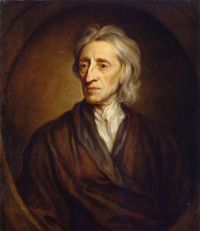
Jean Nicod

Biographical details

Jean Nicod A Reduction in the number of the Primitive Propositions of Logic (1920)

We may notice in general that the new system brings the four functions into relations far closer than those in Mr Russell's system. For instance in
the two propositions and coincide. Every stroke-formula falls into two parts on the right and left of a central stem. It will, therefore, add to clearness to use black type instead of dots to indicate the central symbol. Further, slanting strokes are covered by straight ones: thus stands for .
The definition of the two primitive notions of the Principia in terms of a single new one tends to reduce the number of the primitive propositions needed.
Source: Wikisource

Jean Nicod A Reduction in the number of the Primitive Propositions of Logic (1920)

The reform may be further extended to the proposition (2) as a whole, which might be given in the form instead of with the proviso, if the proposition is to remain true, that must be implied in . Now, for , write the proposition (1) above, ; for (as we at this early stage know "unofficially") a true proposition will be implied by everything.
We then have the three primitive propositions of the stroke-system:
This is the non-formal rule of implication, *1·1, with the modification just explained.
Source: Wikisource

Jean Nicod A Reduction in the number of the Primitive Propositions of Logic (1920)

For the stroke, in the stroke-system, is simpler than either or , and from it both of them arise. We may not be able to think otherwise than in terms of the four usual functions; it will then be more in accordance with the nature of the new system to think of the , not as some fixed compound of and , but as a bare structure, out of which, in various ways, and will grow.
Source: Wikisource

Get perspective with Kwize: daily news enlightened by great literature