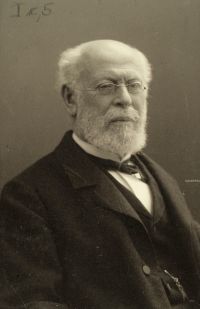
Moritz Cantor

Biographical details

Portrait of Moritz Cantor Moritz Cantor,  1911 Encyclopædia Britannica (1911)

“ Another idea of Stevinus, for which even Hugo Grotius gave him great credit, was his notion of a bygone age of wisdom. The goal to be aimed at is the bringing about of a second age of wisdom, in which mankind shall have recovered all its early knowledge. The fellow-countrymen of Stevinus were proud that he wrote in their own dialect, which he thought fitted for a universal language, as no other abounded like Dutch in monosyllabic radical words. ”
Source: Wikisource

Portrait of Moritz Cantor Moritz Cantor,  1911 Encyclopædia Britannica, Volume 28… (1911)

“ That principle had been made use of by the Greek authors of the classic age; but of later mathematicians only Hero, Diophantus, &c., ventured to regard lines and surfaces as mere numbers that could be joined to give a new number, their sum. It may be that the study of such sums, which he found in the works of Diophantus prompted him to lay it down as a principle that quantities occurring in an equation ought to be homogeneous, all of them lines, or surfaces, or solids, or super solids—an equation between mere numbers being inadmissible. ”
Source: Wikisource

Portrait of Moritz Cantor Moritz Cantor,  1911 Encyclopædia Britannica (1911)

“ Leonardo’s method, therefore, when the difference was a fixed condition of the problem, was necessarily very different from the Arabian, and, in all probability, was his own discovery. The Flos of Leonardo turns on the second question set by John of Palermo, which required the solution of the cubic equation x3 + 2x2 + 10x=20. Leonardo, making use of fractions of the sexagesimal scale, gives x=10 22i 7ii 42iii 33iv 4v 40vi, after having demonstrated, by a discussion founded on the 10th book of Euclid, that a solution by square roots is impossible. ”
Source: Wikisource

Get perspective with Kwize: daily news enlightened by great literature