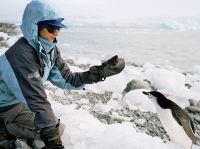
Nusha Ivanova

Biographical details

Portrait of Nusha Ivanova Nusha Ivanova,  The Future of the Falkland Islands and Its People… (2003)

“ There in the White South, beyond the Antarctic Convergence that runs across three oceans to mark the physical boundary of Antarctica, is the Bulgarian base St. Kliment Ohridski on Livingston Island in the Antarctic Peninsula region of Western Antarctica.
People still know little about that continent. It is the highest, driest and coldest place on earth, a land of penguins, seals, glaciers and icebergs, stretching over a vast area of 14 million square kilometres around the South Pole. A continent where few people have had the chance to step on and get touched by its beauty.
”

Source: Wikisource

Portrait of Nusha Ivanova Nusha Ivanova,  The Future of the Falkland Islands and Its People… (2003)

“ The islands are surrounded by the South Atlantic Ocean, and separated from Antarctica by the Scotia Sea to the south. Most of their territory is covered by grass and peat, with no natural forest. The weather is cool and wet in summer, colder and windy in winter. It is very similar to the marine British climate, different from our continental Bulgarian climate that has both real warm summers and real cold winters. Not to be forgotten, the seasons in the Falklands are the reverse of those in the Northern Hemisphere; also the sun travels right to left through the northern part of the sky. ”
Source: Wikisource

Portrait of Nusha Ivanova Nusha Ivanova,  The Future of the Falkland Islands and Its People… (2003)

“ However, Bulgarian biologists in that summer season were carrying out research at the colony of Papua (Gentoo) penguins in a nearby cove, ferried there weekly by Zodiac inflatable boats operating from the Spanish base that is five kilometres away from St. Kliment Ohridski. We are among the few countries that do genetic studies connected with the human interference with the penguin environment. People in Antarctica try to minimize their disturbance of wildlife, that is for instance why Antarctic cruise vessels were permitted to land no more than one hundred tourists ashore at any one time. ”
Source: Wikisource

Get perspective with Kwize: daily news enlightened by great literature